It’s important to start out with the right equipment when you’re bringing a dog home. But how do you pick what might work for your dog before you bring her home?
Crate Training? Yes or No?
There are a lot of different opinions about whether to crate train, if it creates or helps separation anxiety, or if it’s cruel or kind. As someone living in southern California, I want to come at this discussion from a different safety perspective.
Imagine for a moment your phone has gone off. You’re being evacuated. Your shelter allows pets, but they must be crated. You get a crate, and you convince your dog to go in. She’s never been crated before now. Is this high stress situation the best way for her to be introduced to a crate? What about a different emergency, one where your dog ends up being transported by Animal Control? Are these the experiences you want informing your dog’s attitude about crates, and a lack of crate training contributing to these stressful situations?
Plan for the emergency, train for the emergency, and hope you never have it happen. Crate training is an excellent way to make sure your dog is safe, secure, and not contributing to your emergency stress. Car crates are also one of the best ways to keep your dog safe in your vehicle in case of an accident (I recommend Variocage, as it’s what I have in my SUV to keep my service dog safe)
Types of Crates
There are generally two styles of crate: wire and plastic. There are also furniture crates that double as end tables, however I don’t recommend purchasing anything like that until you know how your dog tolerates being crated. Some dogs prefer wire crates where they can see everywhere around them. Others prefer plastic crates and a more den-like feel. On the expensive high end side are metal crates like Impact Crates (they come in two types, escape proof and high durability for travel).
I prefer to start with a wire crate, then switch to a plastic crate if the wire crate isn’t working out. Shelters always can use crate donations if you no longer need a certain type and it hasn’t been wrecked.
Sizing
The correct crate size is one your dog can fully stand up, turn around, lay down and stretch comfortably. That said, some dogs thrive in a much larger crate than their minimum needs, while others want to have as tiny a space to snuggle up in as possible.
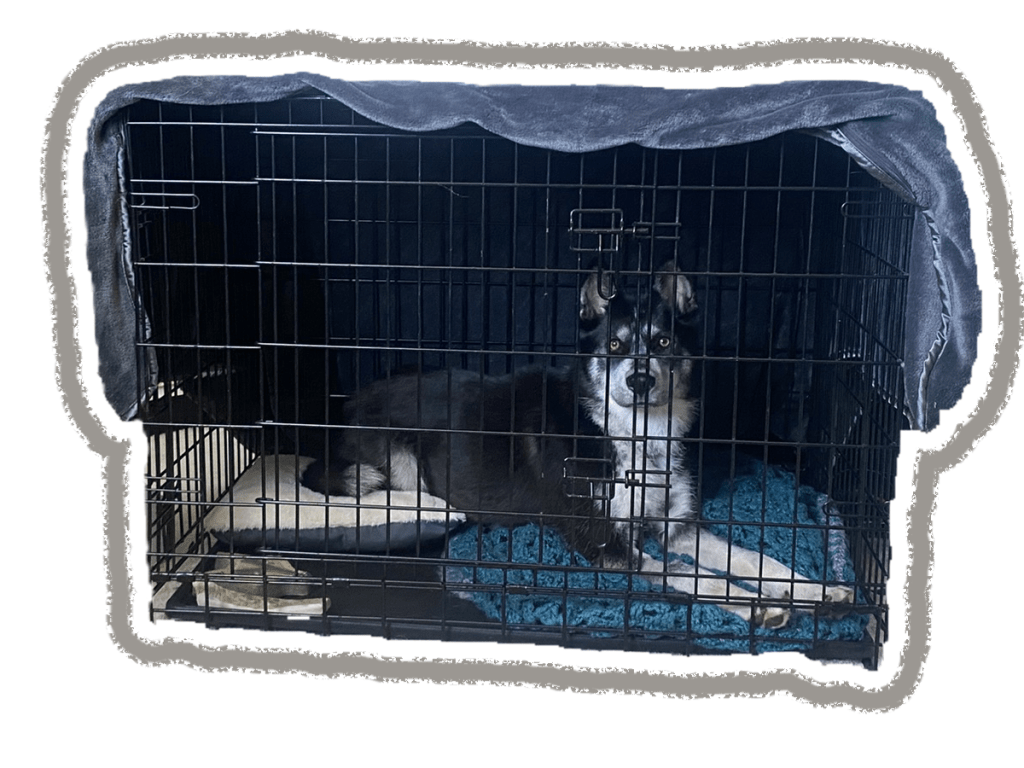
How To Crate Train
You want to make sure your dog doesn’t suffer from confinement anxiety, which is different than separation anxiety!
Separation anxiety means your dog becomes anxious, frightened, destructive, and/or frustrated, when separated from you. Confinement anxiety means your dog may show all of those same emotions and behaviors when confined, regardless of whether or not you are present. Crates can help sooth separation anxiety when trained correctly, but they may exacerbate confinement anxiety exponentially. Dogs with confinement anxiety may do better if placed in a bathroom or other dog proofed room in your home while you’re unable to supervise them until their confinement anxiety has had behavior modification training to reframe how they feel within the crate.
Separation anxiety can be managed through careful, slow increases of the time you’re away from your dog while making the time you’re away from your animal more pleasant. Unfortunately, few of us have the ability to treat separation anxiety in it’s most successful way, meaning no bad experiences of separation.
Subscribe to get access
Subscribe for $2/month to read more of this content, and help support the work of Project Pawsible!
Need help with your dog’s behavior, or are a rescue/shelter who wants help for their fosters? Reach out below!
Your message has been sent




 Project Pawsible
Leave a comment